Georgetown’s research community should understand the risks, restrictions, prohibitions, and disclosure and reporting requirements associated with formal and informal international engagements and collaborations. While certain explicit prohibitions and restrictions apply specifically to federally-funded researchers, any engagement with organizations or employees of organizations on U.S.-designated restricted entity lists must be reviewed and carefully considered in the context of safeguarding Georgetown’s academic and research enterprise and meeting applicable regulatory requirements.
Request a Research Security Consult or Entity Screening
Georgetown has procedures in place to automatically screen university research-related agreements and transactions against restricted party lists in the Visual Compliance vendor platform. For proactive and/or or ad hoc screening or consultation requests related to contemplated collaborations, activities, or co-authorship, contact: researchsecurity@georgetown.edu
The U.S. government maintains a number of restricted party lists, which it routinely updates. These lists identify parties that the U.S. government has flagged as a national security concern.
The Consolidated Screening List (CSL) is a publicly-available tool to query whether an individual or organization is included on key U.S. government restricted party lists. An additional key list to refer to (which is not included in the CSL) is the DoW’s “1286 List “, which identifies foreign entities (including academic and research institutions) and foreign talent programs that the U.S. government has determined are engaging in activities that threaten U.S. national and economic security interests.
Georgetown has procedures in place to automatically screen university research-related agreements, transactions, and collaborations against restricted party lists using the third-party vendor platform Visual Compliance. While proactive individual screening using the links above is encouraged as a protective measure and to facilitate a culture of “knowing your collaborators” in the context of research security, such individual screening does not take the place of the official screening conducted by the University in Visual Compliance in accordance with standard procedures.
Different U.S. government agencies apply and refer to different lists and add new lists over time.
Thinking of initiating a formal or informal engagement with an individual or organization in a foreign country of concern?
Co-authoring a paper with an individual affiliated with an organization in a foreign country of concern?
Invited to attend a workshop, teach a class, or present a lecture associated with an organization in a foreign country of concern?
Considering hosting an academic or research visitor from a foreign country of concern?
Contacted by an individual associated with an organization in a foreign country of concern asking for you to share materials, information, or data?
While Georgetown has procedures in place to automatically screen individuals and entities that are associated with institutional agreements involving Georgetown, proactive screening before you contemplate engagement with foreign collaborators is strongly encouraged. Contact researchsecurity@georgetown.edu for a consultation or screening.
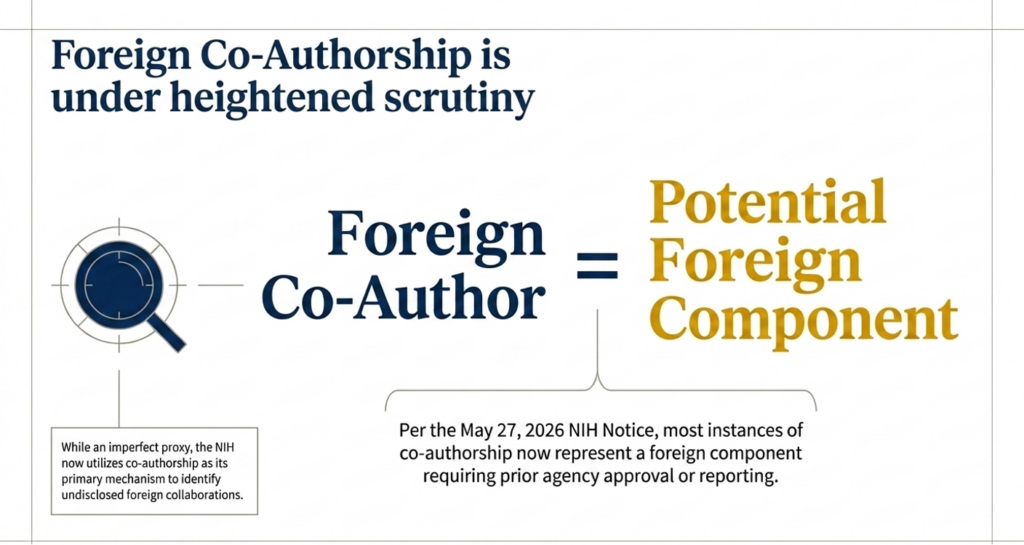
Foreign co-authorship is under heightened U.S. government scrutiny, particularly when papers reference U.S. federal funding and also include co-authors associated with foreign countries of concern.
For proactive and/or or ad hoc screening or consultation requests related to co-authorship, contact: researchsecurity@georgetown.edu
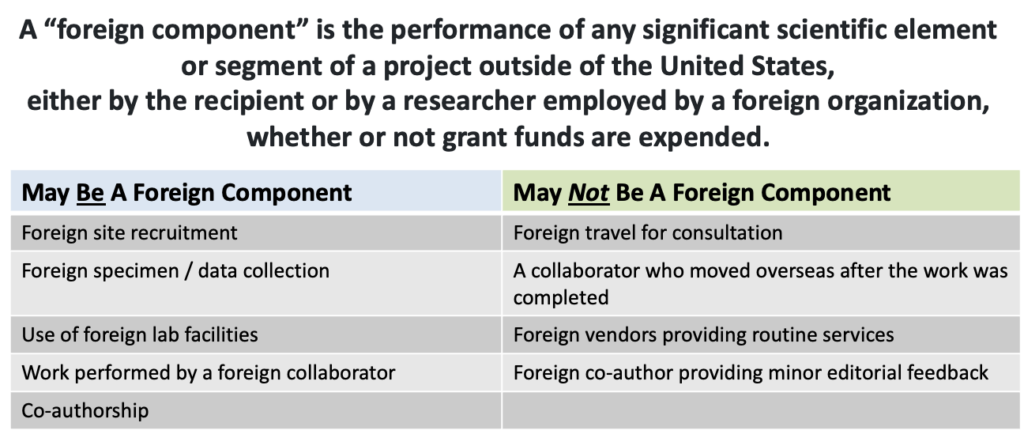
The NIH has communicated that most instances of foreign co-authorship likely represent a foreign component. NIH FAQs on co-authorship and foreign components are available here.
Federal agencies are incorporating into their funding decisions risk factors that include an individual’s associations, collaborations, and co-authorship with organizations on restricted entity lists. Current federal guidance: